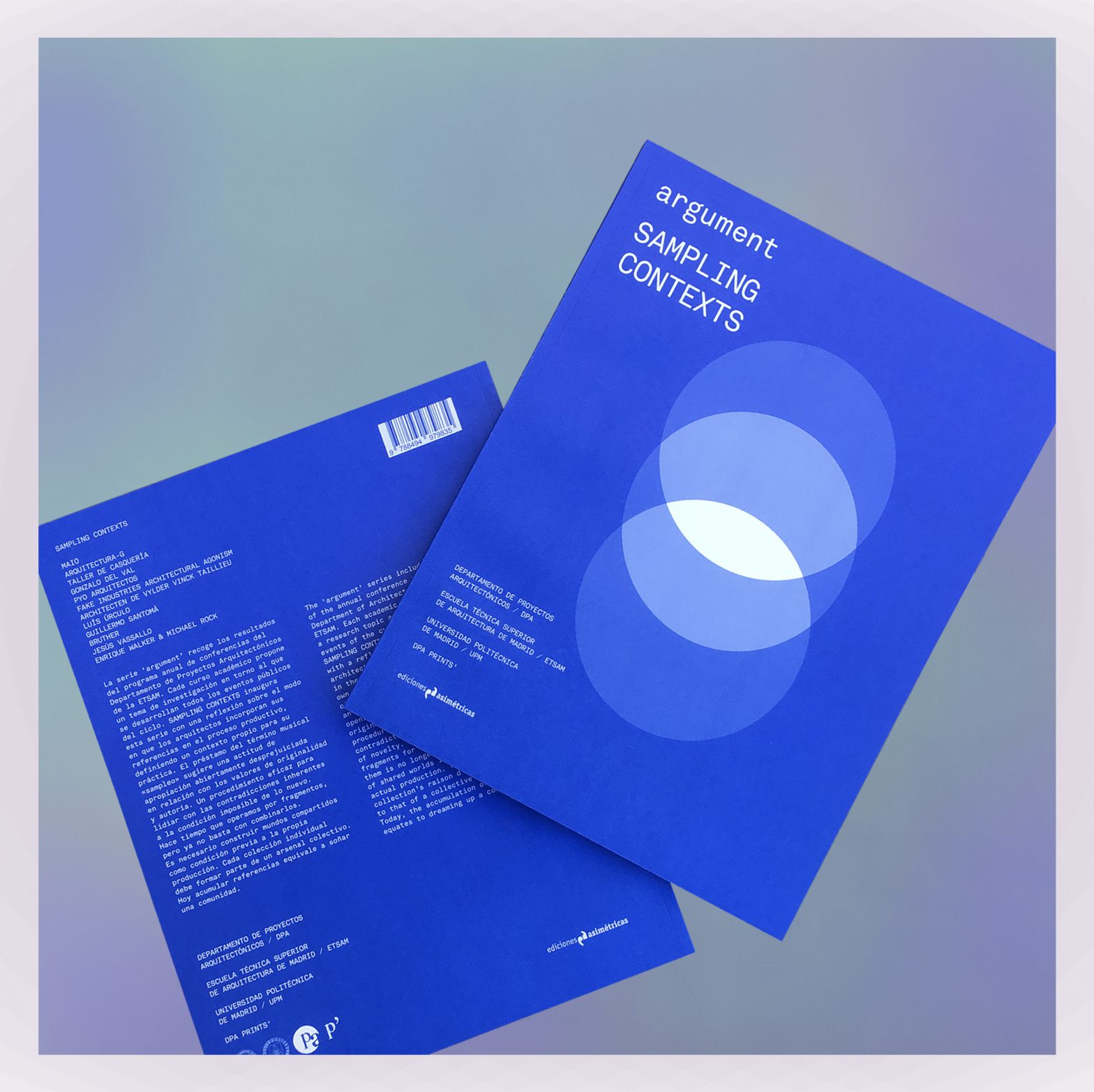
Los números séptimo y octavo de la colección de Textos Críticos co-editada con Ediciones Asimétricas ha sido premiada por el Colegio Oficial de Arquitectos de Madrid en la categoría de Difusión.
ETSAM // UPM
Los números séptimo y octavo de la colección de Textos Críticos co-editada con Ediciones Asimétricas ha sido premiada por el Colegio Oficial de Arquitectos de Madrid en la categoría de Difusión.
El próximo lunes día 17 de mayo traemos al Ciclo de Apoyo al Doctorado a Łukasz Stanek, ganador del último premio de investigación del RIBA en la categoría ‘historia y teoría’ por su libro Architecture in Global Socialism: Eastern Europe, West Africa, and the Middle East in the Cold War (Princeton University Press, 2020), que presentará durante la sesión.
TÍTULO: Architecture in Global Socialism: Eastern Europe, West Africa, and the Middle East in the Cold War
PONENTE: Łukasz Stanek, University of Manchester
DÍA: Lunes 17 de mayo, 17:30 hs. (duración aprox. 90 min.)
AULA ZOOM: etsamupm26
Seminario MPAA 12: Dispositivos de [inter]Mediación.
Lunes, 17 de mayo.
Imagen cartel: Inspiration, Additive architecture. Serie Nature Studies. Jorn Utzon © Utzon Archives / Aalborg University & Utzon Center.
Se publica la composición provisional de los tribunales de Máster Habilitante para la convocatoria de JUNIO y JULIO de 2021.
La relación se encuentra detallada aquí:
Imagen de Portada: Yaiza Camacho
Lab#02 Crítica Práctica. Reacción o Modelos.
Miércoles, 12 de mayo.
Imagen cartel: Inland Steel Building, SOM. Chicago, 1958.
Foto: Ezra Stoller.
Place: Bangalore, India / Virtual
Host:Dayananda Sagar Institutions [College of Architecture]
Dates: March 23/25, 2022
Abstract: June 30, 2021 (early submission)
Call
The starting point for the Sustainable Architecture(s) – Humane Cities conference is a consideration of the United Nations 17 Sustainable Development Goals and how that relates to living through the current tragic situation of Covid-19 in cities. With over 80% of the world’s megacities projected to be in the Global South by 2030 it addresses the challenges faced by the region’s expanding cities: Covid-19, public health, informal development, grass roots participatory design, climate change, resilience, and more. It critiques sustainability from practical, cultural, health perspectives and more. It asks questions about physical distancing, global cities, post-colonialism and spectacle architecture. It examines the relationship between all these issues and questions of social equity and public health, whether it be in Mumbai, Beirut, Cairo, Rio, Lagos or Beijing. In a tragic moment for India’s cities it challenges us to connect questions often kept in isolation. It seeks to connect the work of the designers of our buildings, the planners of our cites, our policy makers at regional levels, and the governors of our expanding urban settlements today. At a critical moment it seeks to share knowledge on the most vexed and pressing issues cities in India, and across the world, face today.
For more information here
Place: New Delhi, NCR, India / Virtual
Host: Noida International University
Dates: March 13/15, 2022
Abstract: June 30, 2021 (early submission)
Call
Set in the context of the Indian government’s 100 Smart Cities Mission the Architecture, History and the Smart City conference seeks perspectives on the past, present and future of our cities. Given the current situation in India it has a special strand on technology and Covid-19. Whether it be Covid-19 tracking apps in Delhi, computational architecture of London, urban planning of New York, transport systems of Dubai or e-communities in Mumbai, it sees the role of technology in the creation and management of the built environment as integral to the modern metropolis. However, it simultaneously wishes to understand the myriad of non-digital issues at play today: social distancing in public space, the design of housing, the planning of commercial developments, the management of urban sprawl, and much more. To complete its picture of the complex future city, it also explores the origins of public health in the city, architectural and urban heritage, the conservation of ancient monuments, and the preservation of long standing cultural traditions. In the fast changing urban setting of the smart city it seeks a practical and historic understanding of the past and the future that can help today
For more information here
Place: University of Calgary, Canada / Virtual
Dates: June 28/30, 2022
Abstract: July 01, 2021 (early submission)
Call
‘The Countryside’ – a polemically generic term Rem Koolhaas has recently used to reposition debates about our cities to those of rural areas. While posited as ‘new’, it is, in reality, a well established mode of thinking. Through notions such as the peri-urban for example, geographers, sociologists, architects, urban designers and regional economists have all debated the urban-rural relationship for several decades. Under this framework we are obliged to consider the city and its architecture on its own terms, but also address the ‘rural’ in its particular context and, importantly, explore the parallels and mutual influences at play.
Themes
Design + Planning – how are we working in our individual fields and across disciplinary and geographical boundaries
Society + Cultures – What voice do people and cultures have in design and planning practices and how do mechanisms for participation function
Art + History – how does the history of a discipline or place influence design and planning today, and what role do creatives, critics and commentators play in the debate
Infrastructure + Sustainability– how do the infrastructures we design and build impact people, habitation, sustainability and climate
Teaching + Learning – how we address issues of design, culture and community in our teaching approaches, projects etc.
For more information here